- (330) 600-5356
- timtoptier3@gmail.com
- 7586 Township road 652, Millersburg, OH 44654
We install seamless aluminum gutters for homeowners across eastern Ohio. Seamless means no joints, and no joints means nothing to split, sag, or leak a few years in. We’re an Amish-owned company, and the same craftsmanship we put into a roof goes into the gutters that protect it.
We will call you back and schedule a time to look at your roof and give you a estimate or quote on the services you want.
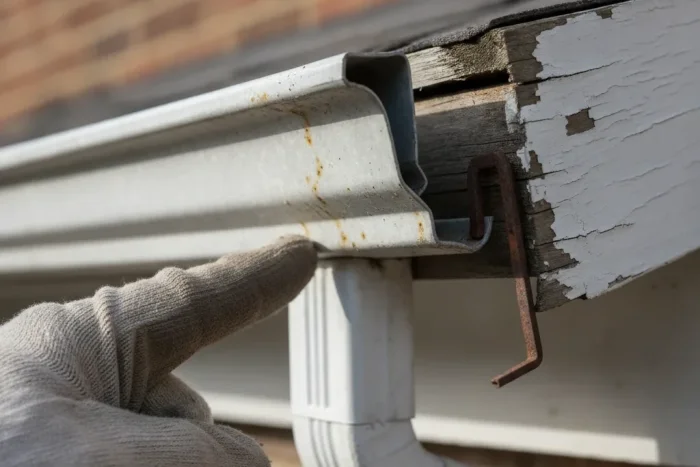
Water spilling over the edge, sagging sections, and stains on your siding show your gutters are not working. Catch these early to avoid bigger repair bills from foundation or fascia damage.
We get calls every week from folks who notice water pouring off the roofline during a heavy rain. It looks like a waterfall, not a quiet trickle into the downspout. That’s usually the first sign something’s wrong. Old sectional gutters develop gaps at the seams over time. Those gaps let water dump straight down the side of the house.
Sagging is another sign. If you see a gutter pulling away from the fascia board, or dipping in the middle instead of running straight, the hangers are failing. Left alone, that section can tear loose in a windstorm.
Basements with a musty smell after a storm are worth checking too. This often traces back to a gutter dumping water right at the foundation instead of carrying it away.
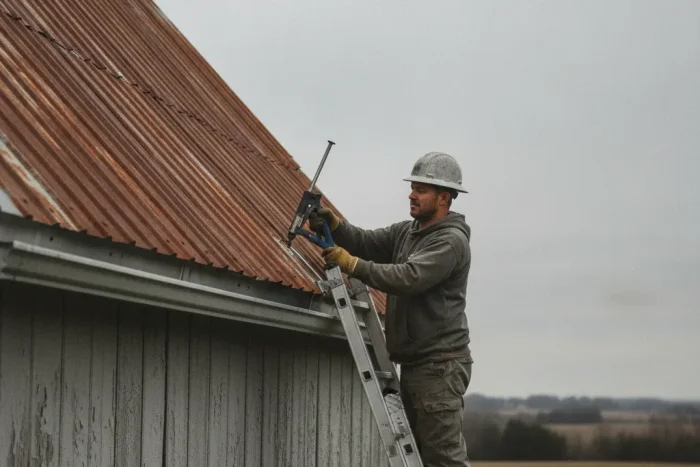
Many homes and barns out here have steep metal roofs. That’s just how it is in farm country. A steep metal roof moves water fast, much faster than a low-pitch asphalt roof.
A standard 5-inch gutter can handle a normal roof fine. Put it under a steep metal barn roof, and it gets overwhelmed the second a real storm rolls through. Water sheets off that metal in a rush. It hits the gutter and skips right over the front edge. We see this every week on barns and outbuildings with gutters that were sized for a house, not a farm roof.
So what fixes it? A bigger gutter, tighter hanger spacing, more downspouts. On a steep metal roof, we often use 6-inch seamless gutters instead of 5-inch. Hangers get spaced closer together because the water hits with more force and weight during a heavy rain.
Barns are a different animal, too. Long rooflines mean long gutter runs. Long runs need extra downspouts, or the middle of the run backs up before the ends ever fill.
If you’ve got a metal roof on the house or a barn with gutters that overflow whenever it storms, that’s not a fluke – it’s a sizing issue. Give us a call and we’ll take a look at the pitch and the run before we quote anything.
Get a Free In-Person Estimate. Top Tier Roofing & Exteriors is ready to help.
Not every gutter problem means you need a whole new system. We say this even though replacement pays us more. If your gutters are seamless already and less than ten years old, a leak or a loose section is usually a repair job, not a teardown.
Seamless gutters are built as one long piece with no seams down the run. So when there’s a problem, it’s almost always at a joint, a corner, or a downspout connection. That’s a small fix.
Those are repair situations. We fix them, we’re done, you’re covered for years.
Full replacement makes sense when the aluminum has thinned out across the whole run, when the fascia board behind it is rotting in multiple spots, or when the pitch is wrong everywhere and water just sits instead of draining toward the downspouts. That’s not a repair. Patching a system that’s failing at its foundation wastes your money and ours.
Seamless gutters aren’t pulled off a shelf. They’re formed right there in your driveway, cut to the exact length your roofline needs. No seams every ten feet means fewer spots for leaves to catch and fewer spots that leak down the road. Here’s how it goes on install day.
Most homes take one day, sometimes less depending on the roofline. Because we’re Amish-owned, you’ll notice the work leans on craftsmanship over shortcuts. We’ve built plenty here in Millersburg where steep roof pitches and older fascia boards mean the fit has to be right the first time. Not sure if your fascia can handle new gutters? That’s a fair question, and it’s why we check it before we ever roll a single piece of aluminum. Give us a call at (330) 600-5356 and we’ll set up a free estimate to look at your roofline in person.
Holmes County winters are no joke. We get hard freezes, then a warm afternoon, then freeze again. That cycle is rough on gutters.
Seamless gutters handle it better than sectional ones, but they’re not invincible. Ice can still build up along the edge and pull the whole run loose from the fascia. We see this every week once the snow starts piling up around Millersburg rooftops.
So what causes trouble? Usually it’s a clogged downspout freezing solid, or snow sliding off a metal roof and packing the gutter full. Once water has nowhere to go, it backs up under the shingles. That’s how small ice problems turn into real damage fast.
Not sure if your gutters can handle another Ohio winter? That’s a fair question, and it’s a common one this time of year.
We’re Amish owned, and we’ve been doing this kind of exterior work since we were teenagers. We understand what winter does to a home around here. We’d rather catch a weak spot in November than fix a mess in February.
Get a Free In-Person Estimate. Top Tier Roofing & Exteriors is ready to help.
Most jobs get scheduled within a week or two after your free estimate, depending on how busy the season is. We walk your roofline first, check the fascia boards, and then form the aluminum right in your driveway. That means no waiting on factory sections to ship in. Once we’re on site, most homes are done in one day. Give us a call and we’ll give you a real timeline based on your roof, not a guess.
On install day, we check your fascia boards for rot, roll aluminum coil into one seamless piece cut to your exact roofline, and fasten hangers into solid wood. We set the slope with a level so water runs toward the downspouts instead of sitting still. Downspouts go where they’ll drain your yard well. Before we leave, we clean up every scrap of aluminum and old fastener. Most homes are finished in a single day.
Steep metal roofs push water off much faster than a low-pitch asphalt roof, so a standard 5-inch gutter often can’t keep up. Around Millersburg, we see this a lot on farmhouses and barns with steep metal roofs. Water sheets off fast and skips right over a gutter that’s sized for a regular house. We fix it with 6-inch seamless gutters, tighter hanger spacing, and extra downspouts on long barn runs. That combination keeps water moving where it belongs during heavy storms.
If your gutters are already seamless and less than ten years old, a leak or sagging section is usually a repair, not a full replacement. Seamless gutters run as one piece, so trouble almost always shows up at a corner, joint, or downspout connection. That’s a quick fix. Full replacement makes sense when the fascia is rotting in several spots or the whole run has lost its pitch. If you’re not sure which one you’ve got, that’s the most common question we hear, and it’s worth a quick call.
Yes, seamless gutters handle Holmes County winters better than old sectional systems, but they still need attention. Our freeze-thaw cycle around Millersburg puts a lot of stress on gutters, especially when a clogged downspout freezes solid or snow slides off the roof in one heavy load. That weight can pull a run loose from the fascia if the hangers aren’t solid. Keeping downspouts clear before the first hard freeze goes a long way toward getting your gutters through winter without damage.