- (330) 600-5356
- timtoptier3@gmail.com
- 7586 Township road 652, Millersburg, OH 44654
In Millersburg, heavy tree cover and hilly Holmes County terrain push gutters hard every fall and winter. Clogs build up fast, runs start to sag, and ice puts real strain on the seams. That’s the kind of Gutter Service work Top Tier Roofing & Exteriors handles every day for homes across this area. This page walks through installation, repair, replacement, removal, seamless and aluminum systems, gutter guards, residential gutters, and downspout work, so you can see which one fits your property. We’re an Amish-owned company based right here in Millersburg, and owners Timothy Miller and Jonathon Miller bring 16 years of combined construction experience to every gutter job we take on. Read through each section below to find the service that matches your roofline, then reach out and we’ll walk through it with you. We offer free estimates, so there’s no cost to finding out what your home actually needs.
We will call you back and schedule a time to look at your roof and give you a estimate or quote on the services you want.
Some homes just don’t have gutters yet. Maybe it’s new construction, a new addition, or a house where the fascia has always been bare. That’s where gutter installation comes in. We size a full run to match your roofline and hang it along the fascia so water has somewhere to go besides your foundation.
Honestly, this is the step people underestimate. A gutter that’s not sized right for the roof will overflow the first time it rains hard, no matter how well it’s hung. That’s why we look at the whole roofline before we start cutting material.
A lot of rural Holmes County properties aren’t just one building. Many include a barn or an outbuilding or two alongside the main house, and a full installation job often needs to cover more than just the home itself. That changes how we plan the runs and where the water needs to end up.
Gutter installation applies when there’s no system in place at all. If you’ve already got gutters that are failing, that’s a different job – we cover that next.
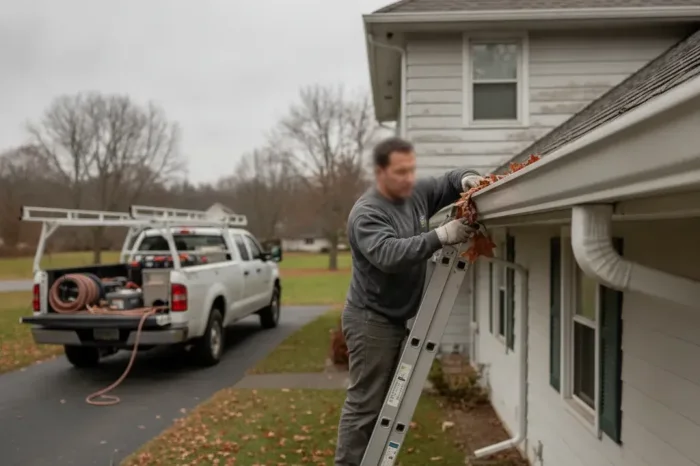
What does “seamless” actually mean? It’s not a brand name or a marketing term. It describes how the gutter gets built. Instead of connecting short factory-cut sections with seams every few feet, we fabricate the gutter on site as one continuous piece, cut to the exact length of your roofline.
Fewer seams means fewer spots where water can work its way out. That matters a lot around here. Homes in the hill country around Millersburg go through repeated freeze-thaw cycles each winter, and that stress hits gutter seams and joints hardest. A seamless run just has less to fail.
Seamless describes how the gutter is made, not what it’s made of. That’s a different question, and it’s one we cover in the next section on aluminum gutters. A seamless gutter is often aluminum, but the two terms aren’t answering the same thing – one is about the build, the other is about the material.
See our seamless gutter services
See how Seamless Gutters in Millersburg cut down leak points, then call us to schedule a look at your roofline.
At some point, a gutter stops being worth patching. Sagging runs, rust spots, pulling away from the fascia, water finding new ways out every time it rains – that’s a system telling you it’s done. Gutter replacement takes the old one down and puts up a new system built to match your current roofline and fascia condition.
We get it – nobody wants to hear “you need a whole new system” when a patch job sounds cheaper and easier. But repeated patch-repairs on an aging system often end up costing more over time than just replacing it once and being done. Once the fascia or the hangers are compromised, there’s only so much a repair can hold together.
Replacement is about swapping a system that’s already there. If your home has no gutters at all right now, that’s gutter installation, not replacement – two different jobs with two different starting points.
Get a Free In-Person Estimate. Top Tier Roofing & Exteriors is ready to help.
Not every gutter problem needs a full system swap. Sometimes it’s one bad section – a leak at a joint, a hanger that’s come loose, or a low spot that holds water instead of draining it. Gutter repairs fix that one section while the rest of the system stays right where it is.
Here’s what a repair call usually covers:
Spring storms across Holmes County are usually what bring on the repair calls. Wind and heavy rain loosen hangers or reopen old seams that were fine all winter. If that’s what you’re dealing with, a repair might be all you need.
Repairs keep the system up and fix a section. Gutter removal is the opposite – taking the whole thing down. We cover that later on this page.
If your property backs up to trees or sits on a wooded lot, you already know the fall cleanup routine. Gutter guards cut down on that. A cover or screen sits over the gutter opening, blocking leaves and big debris while still letting water flow through and drain like it should.
Dense tree cover across Holmes County means wooded and hillside lots fill up with debris a lot faster than open, cleared properties do. If you’re climbing a ladder every few weeks in October, that’s usually the sign guards would help.
One thing worth saying plainly: guards don’t mean you never think about your gutters again. They cut down on the big stuff – leaves, twigs, seed pods – but fine sediment and pine needles can still work their way in over time. It’s a big reduction in maintenance, not a total end to it.
Guards work best paired with a system that’s already in good shape, seamless or not.
Deciding what to install a gutter system out of is its own question, separate from how it’s built. Aluminum is a common choice for good reason – it’s lightweight, it resists rust, and it can be shaped to fit standard residential rooflines without much trouble.
We mentioned this earlier with seamless gutters, and it’s worth repeating clearly: aluminum describes the material, seamless describes the build method. A seamless gutter is often made of aluminum, but you could ask about one without asking about the other. They’re separate decisions that happen to overlap a lot in practice.
For most homes in this area, aluminum holds up well against the freeze-thaw swings we get through the winter months. It doesn’t rust out the way older steel systems can, and it’s light enough that it doesn’t put extra strain on the fascia over the years.
If you’re weighing material options for a new system or a replacement, aluminum is usually where we start the conversation.
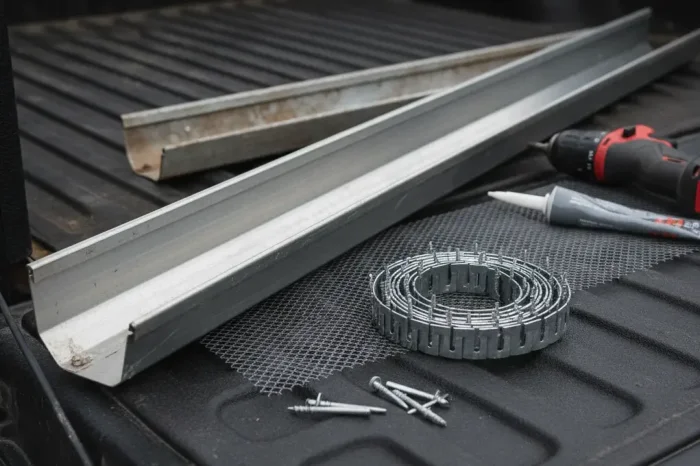
“Residential gutters” isn’t a different installation process. It’s a way of saying the system is sized and styled for a home, not a commercial building or a bare agricultural structure. The roofline size, the trim style, the fascia condition – all of it factors into what a residential system should look like.
Millersburg has a real mix of housing stock. Older homes closer to downtown often have narrower fascia and trim details that need matching, while newer construction out in the rural parts of the county tends to have longer, simpler rooflines. Both need a system, but they don’t need the same one.
Residential gutters is about the property type and what it calls for. Gutter installation, which we covered near the top of this page, is the actual work of putting that system up. Think of one as the “what” and the other as the “how.”
If you’re not sure what your home’s roofline actually needs, that’s a conversation worth having before any material gets ordered.
Here’s a question we hear a lot: does replacing the gutters also mean replacing the downspouts? Sometimes yes, sometimes no – and that’s exactly why this is its own service. Gutter and downspout replacement means both the horizontal run and the vertical downspouts come down and go back up together as one matched system.
This makes sense when the whole system has aged out at once. Old downspouts often show wear at the same time as the gutters themselves – rust at the seams, sections pulling apart, elbows that don’t sit right anymore. Replacing both together means everything matches and drains the way it’s supposed to.
Gutter replacement by itself can leave downspouts as a separate line item, handled on their own timeline. This service bundles the two so you’re not doing the job twice. It’s a good fit when you already know the whole system needs to go, not just one part of it.
We’ll walk your roofline with you and tell you honestly whether a bundled job or a gutters-only job makes more sense for your house.
We offer free in-person estimates. Let us schedule a time to take a look at your roof and get you the help you need.
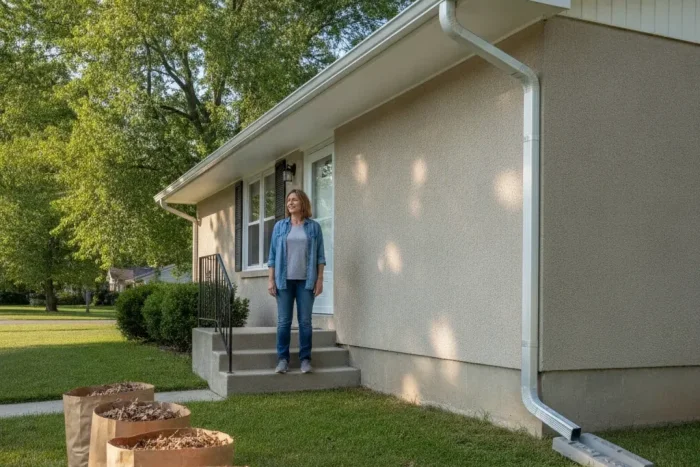
Downspouts do the last, most important part of the job – taking water that’s collected in the gutter and getting it away from your house. Downspout installation covers adding new downspouts or extending existing ones, without touching the horizontal gutter run at all.
A few reasons homeowners call for this on its own:
Rural properties around Millersburg with long barn rooflines or multiple outbuildings often need more downspouts than a standard home would, just to keep up with how much water a big roof surface sheds during a heavy rain. One downspout on a hundred-foot barn run isn’t going to cut it.
Downspout installation covers the vertical pipes only. Gutter installation, covered earlier, is the horizontal run along the roofline itself – a related but separate piece of the system.
Before a new system goes up, sometimes the old one has to come down completely. Gutter removal is a full tear-out – crews strip the existing gutters and all the hardware, leaving the roofline clear and ready for new work.
This isn’t always tied to a replacement job. Some homeowners need removal ahead of siding work or a renovation project, where the old gutters are just in the way of other work getting done. Other times it’s step one of a bigger gutter replacement project.
Removal takes the whole system off the house. Gutter repairs, covered earlier on this page, leaves the system in place and fixes one section at a time. If you’re only dealing with a leak or a loose section, removal is more than you need. But if you’re clearing the way for something new, it’s the right starting point.
We’ll haul off the old material and leave your roofline ready for whatever’s next.
Call us today to schedule your Millersburg gutter service. We’re an Amish-owned company offering free estimates on every job, so give us a call and let’s talk through your roofline.
Downspouts do the last, most important part of the job – taking water that’s collected in the gutter and getting it away from your house. Downspout installation covers adding new downspouts or extending existing ones, without touching the horizontal gutter run at all.
A few reasons homeowners call for this on its own:
Rural properties around Millersburg with long barn rooflines or multiple outbuildings often need more downspouts than a standard home would, just to keep up with how much water a big roof surface sheds during a heavy rain. One downspout on a hundred-foot barn run isn’t going to cut it.
Downspout installation covers the vertical pipes only. Gutter installation, covered earlier, is the horizontal run along the roofline itself – a related but separate piece of the system.